Looking
for a unique crop to grow, hardy kiwi (actinidia arguta) was Dave's choice.
Pioneering, Passion,
Perseverance, and Pride are the korner stones of our organic farm Kiwi Korners, located in Central Pennsylvania.
Founded in
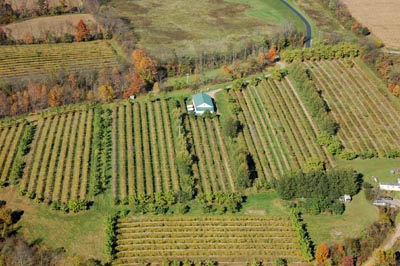
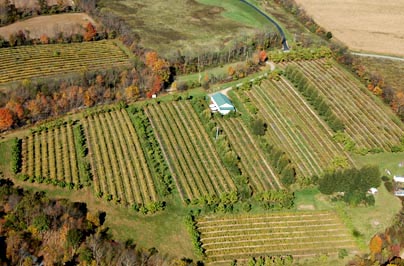
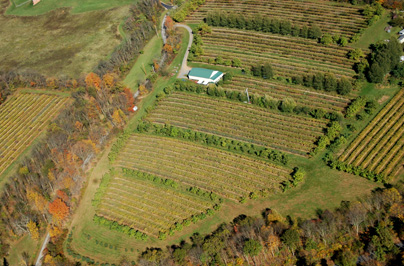
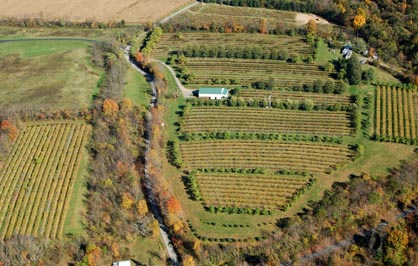
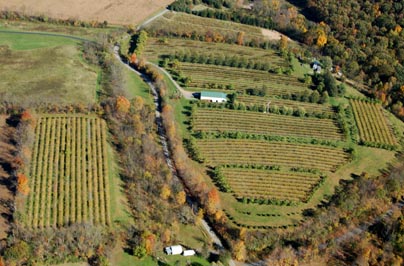
1988, the farm consists of forty plus acres, twenty of which are designated to
grow hardy kiwi.
This area, separated into
eight different arbors, offers three distinct micro-climates.
Kiwi Korners
was built from the ground up, not something constructed by others or
purchased. Building
a first generation family farm, and being the caretakers of the land, we
are
obsessed with putting out a quality product.
It began with
a two acre block of trellis built on a no-till corn field.
Our test trials contained the
largest assortment of hardy kiwi assembled in the Northern Hemisphere. Over
fifty named and numbered varieties, from all over the world, were trialed in
conjunction with a breeding program.
Our goal was
to: A) Identify the best varieties, B) Implement a breeding program, C)
Develop the best management systems for chosen varieties, and D) Create
a market for our fruit we named KiwiBerries.
We outlined fruit qualities that
would determine the best varieties which were: flavor value, sugar level, appearance, and
marketability. We have learned that it takes 8-12 years to bring a vine
into "full" production, and have
refined a multitude of management practices and protocols that contribute to the successful
production and marketing of this unique, specialized berry.
Initially four of the fifty named
and numbered varieties test trialed were deemed to be commercially viable
and
made the grade to qualify as kiwiberries. We can boast many firsts...one of
which was marketing our hardy kiwi
fruit under the "KiwiBerries"
name in 1998.
Growth from that
point was
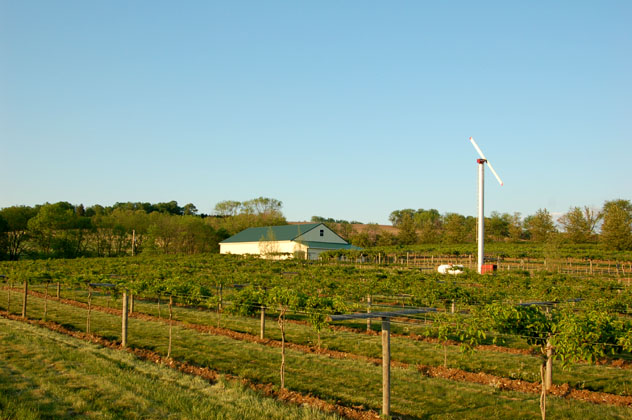
realized on multiple fronts. Our farm building with cold storage was erected and
we purchased the first of two pack lines.
A wind machine was added to
the arbor to protect our vines against spring frost.
From
1988 to 1992, we increased our plantings, half in test trials, and the other half
was planted in Annas to produce a fruit crop for the market.
We
made the decision to become certified organic, and transcended into certification without the three year transitional period, as we had been
utilizing those management practices from the beginning.
We developed our Passion Popper
variety, currently the market favorite that sells out before the crop is
harvested.
We were the
recipients of a SARE Grant
that we titled "Hardy Kiwi Pollination & Production" testing various
hardy kiwi pollination methods. There was little known about male
varieties at that time. Our research
provided key
information to support hardy kiwi as a commercial crop.
In 2006, we added another three
arbors over six acres. Currently there are 20 acres under
trellis and dedicated to hardy kiwi. Passion Poppers were planted in the
new arbors, and the original test trial arbor was also transitioned into a commercial production
block.
We reduced the number of
cultivars that we package for the fresh fruit market from four to two which are our
Passion
Poppers, and the
Aloha Annas that are available today.
There have been countless exploratory,
hands-on trips visiting scores of breeders, growers, and research stations to
exchange information and evaluate hardy kiwi varieties and cultural methods.
Some of the
research locations in our travels have included Oregon, Oregon State University,
Washington State, Vancouver Island, Canada Ministry of Agriculture, Food, &
Rural Affairs - Agassiz and Abbotsford Research Stations - British Columbia,
New Zealand - Institute for Plant & Food Research
Stations (previously HortResearch) - North & South Islands - New Zealand, and
Hogeschool Gent in Belgium.
We
have provided
vine stock for test trials to numerous land grant colleges in the US that
include Penn State, Cornell, Alabama A&M, and
Auburn Universities.
Research, workshops, and
presentations are shared on an international basis with universities, research
facilities, and growers. We
also work with School Nutrition Directors, and Associations with an
interest in including kiwi berries in their school food programs for its
nutritional values.
As of 2024, we have been researching, developing, and growing hardy kiwi (actinidia
arguta) for thirty-six (36) years.
We grow kiwiberries because it’s our passion.
We do this
organically so they are safe to eat, and contain high Brix (sugar levels) which
produces superior nutrient content, and optimal flavors.
Our choice
of hardy kiwi variety, customized trellising, land management
systems, and the pre and post harvest handling practices that we have developed
for this crop has produced the world’s sweetest, highest Brix (sugar
level)
reading of any actinidia
genus documented internationally.
Testing was conducted by the
Penn State University Department of Horticulture Foolad
Labs, University Park, PA in 2009.
Breeding and
trials are an ongoing endeavor. We maintain two juvenile rows that will hold 400 plus vines for test trials, and
breeding evaluation.
We
currently sponsor six incubator farms in Pennsylvania, Maryland, and New
Jersey who are growing and evaluating hardy kiwi varieties from Kiwi Korners.
We continue to establish the next generations
“best of the best”...perhaps a variety that rivals the Passion Popper.
Presently we are testing three new hybrids. The "Quest for the Best"
continues...
|
Originality |
Leadership |
Innovation |